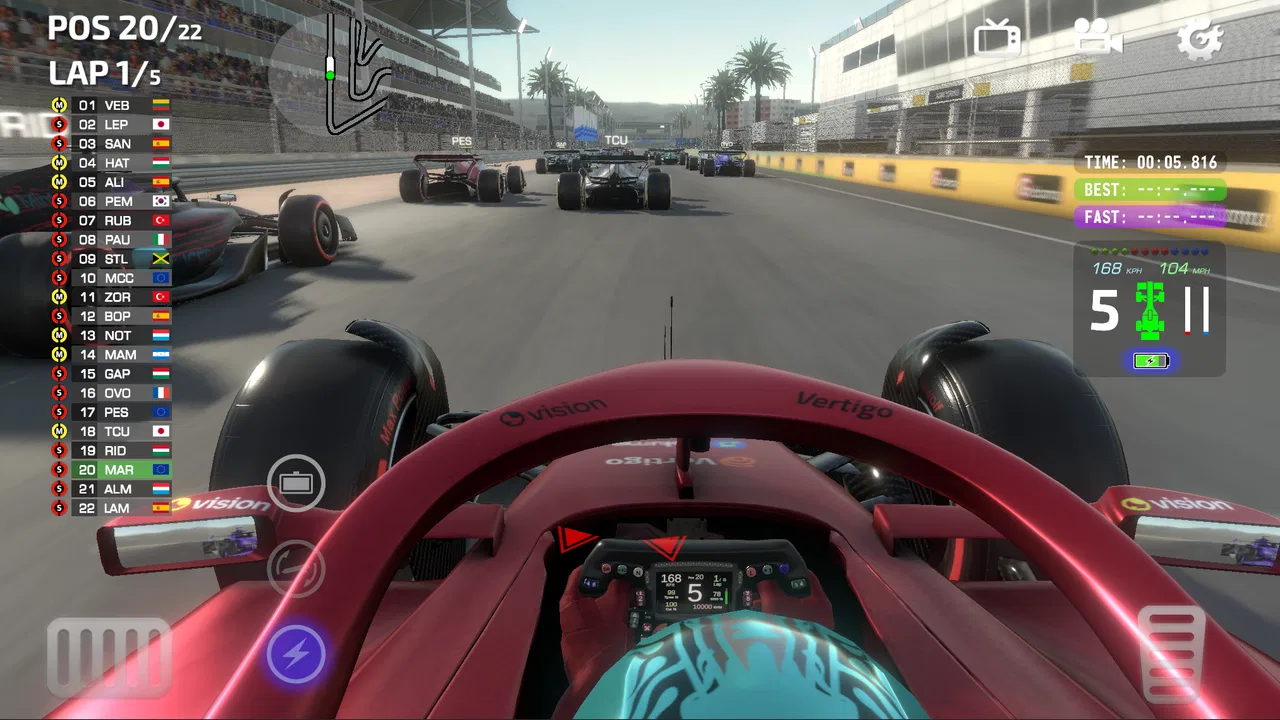
Monoposto
- 4.1
- Rating
- 10.00M
- Installs
- Free
- Price

 Analysis by App-foxy
I spent time with Monoposto as a compact racing game built around open-wheel cars, and its appeal became clear quickly: it tries to put the feeling of a single-seater race into a format that is easier to pick up than a full simulation. I like that balance. It is free to start, rated for Everyone, and developed by Marco Pesce, so it feels aimed at a broad audience rather than only experienced racing fans.
What makes it worth considering is not simply the subject matter. Plenty of racing games promise speed, but this one is most interesting when you want a focused driving session without committing to a large open-world game or a heavily structured console-style experience. I found it better suited to short bursts, repeated practice, and players who enjoy learning how a car behaves through corners.
The game has reached over ten million installs and holds an average rating of 4.3 from around sixty-four thousand ratings, which suggests that its straightforward approach has connected with a substantial audience. That does not make it perfect, but it does give the game a useful sense of identity: this is a dedicated racing experience, not a general driving app with a few cars added on.
You May Also Like

 Blood Strike: 2.5 Anniversary
Blood Strike’s Loadouts Turn Every Drop Into a Tactical Gamble
A close look at Blood Strike’s custom loadouts: how fast access to signature weapons reshapes its battle royale rhythm, rewards preparation, and narrows the gap between fights.

 Pandora - Music & Podcasts
Pandora’s Music Is Easy to Start, but Harder to Recover
Pandora’s strength is its low-effort path from a seed to a station. Its weak spot is how much confidence it asks you to place in connection, setup, and quiet recovery.

 8 Ball Pool
 Is Built on Rivalries, Rematches, and Routine
A close look at the rivalries, rematches, shared routines, and unanswered safety questions that turn a quick pool match into a persistent mobile community.

 Samsung Music
’s Quiet Strength Is Playing What You Already Own
Its reach comes less from spectacle than from dependable access to a personal library. That simplicity is both the app’s strongest retention engine and its ceiling.

 AccuWeather: Weather Radar
AccuWeather Review: A Quick, Clear Forecast for Everyday Decisions
For everyday plans, the best forecast is the one you can understand quickly. AccuWeather makes rain timing, radar, and local conditions easy to act on, with a few trade-offs.

 Hill Climb Racing
Why Hill Climb Racing Still Turns Crashes Into One More Run
A tiny car, a bumpy hill and one more upgrade: Hill Climb Racing keeps resurfacing because its simple chaos makes every near-miss feel personal.
More From Our News Desk



How the game feels to use in different situations
I’ll focus on how Monoposto’s concentrated open-wheel racing changes with your setting, attention, and available time, since those factors can matter as much as driving skill. I also want to consider a practical way to make each attempt feel manageable, before turning to the specific situations where this style of racing works best.
Readability and navigation during a race
My first impression was that Monoposto is easier to understand than many racing games that immediately surround the player with menus, upgrades, currencies, and competing objectives. The open-wheel focus gives the experience a clear center. You are there to drive, judge corners, and improve your control rather than sort through a long list of unrelated activities.
That clarity matters for players who prefer predictable navigation. A racing game can become tiring when every session begins with several layers of setup, but this one works best when the route from opening the game to getting on track feels direct. I also found that a clean racing focus makes it easier to concentrate on the road instead of constantly checking secondary systems.
For readability, the important information in a racing game is usually the information that can be understood while moving: the shape of the circuit, the position of nearby cars, braking opportunities, and any visual signal that helps with timing. I would not treat Monoposto as an automatically accessible experience for everyone, because fast driving naturally limits how long you can inspect anything on screen. Still, its focused presentation is less distracting than the cluttered interface found in some free racing alternatives.
A useful habit is to spend the first few sessions learning the circuit rather than chasing a perfect result. I found that trying to memorize where the car needs to slow down is more productive than staring at every interface element. Once the basic route becomes familiar, attention can move toward smoother steering and earlier acceleration.
This is also where the game differs from open-world racers. An open-world title is excellent when I want to explore, discover activities, or simply drive without pressure. Monoposto makes more sense when I want a defined racing task. That narrower structure can be a strength for players who become overwhelmed by too many choices, although it may feel restrictive if exploration is the main reason you play driving games.
Motor control and sensory demands
Driving an open-wheel car on a small touchscreen asks for continuous motor control. Steering, correcting a slide, managing speed, and responding to corners all happen in quick succession. I found that the game rewards light, deliberate inputs more than frantic movements. Pressing and holding controls too aggressively makes it harder to settle the car before a bend.
That creates an important trade-off for people with limited dexterity, tremor, slower reaction times, or discomfort from repeated touch gestures. A player who can make small corrections may enjoy the precision, while someone who needs larger forgiving inputs may find the car difficult to keep steady. I would approach it as a game that benefits from experimentation with control positioning and input pressure, rather than assuming the default setup will suit every hand.
Playing with both hands can make a noticeable practical difference. I prefer keeping the device supported and using the least movement necessary, especially during longer sessions. This reduces the temptation to lift a thumb or reach across the screen at the exact moment a corner requires attention. It is a small technique, but it makes the game feel less tiring than trying to control everything with one hand.
Sensory demands are just as relevant. Racing involves rapid visual movement, repeated changes in direction, and the pressure of reacting before a corner arrives. Players sensitive to motion or visual overload may prefer shorter sessions and lower intensity. I would also avoid judging the game after only a few minutes, because the first exposure can feel busier than later attempts once the circuit layout becomes familiar.
Sound can be useful in racing because engine changes and other audio cues may help a player sense speed without looking at the car constantly. However, I would not rely on sound alone for critical information. Visual attention remains central, and anyone who plays with audio reduced or disabled should expect to depend more heavily on what is happening on screen.
One practical tip is to treat practice as an accessibility tool, not merely a competitive feature. Repeating the same section lets you reduce the number of decisions made at once. First learn the corner, then the braking point, then the exit. Breaking the task into those stages is more comfortable for players who find rapid multitasking difficult.
Short sessions, shared spaces, and everyday use
Monoposto fits naturally into small gaps in the day. I can imagine playing it while waiting for an appointment, during a commute break, or at home when I want something more engaging than a quick puzzle but do not have the energy for a long campaign. The racing format gives each session a clear purpose, so I do not need to invent a reason to stop.
That does not mean every environment is equally suitable. In a moving vehicle, a crowded room, or a place with frequent interruptions, racing becomes harder because a missed moment can send the car off line. I found it better to play when the device could remain steady and my attention would not be pulled away every few seconds.
Screen size also changes the experience. On a larger phone, the track and controls have more breathing room. On a smaller display, the same race can feel more compressed, especially if your fingers cover part of the action. Players with reduced vision or difficulty distinguishing small details should consider whether their device gives them enough space to follow the road comfortably.
The game’s Everyone age rating makes it approachable for families, but that should not be confused with effortless play. Younger players may understand the racing idea immediately yet still need time to learn braking and steering. I would introduce it as a game of gradual control rather than one where winning should happen on the first attempt.
For someone who plays during breaks, I recommend setting a personal stopping point before beginning a race. Racing games can encourage “one more attempt,” particularly when a mistake happens near the end. A planned limit helps prevent frustration and makes the game more suitable for players who need predictable session lengths.
What still creates barriers
The biggest barrier is the speed of the activity itself. Even a well-organized racing interface cannot remove the need to react to a changing track. Players who need more time to process visual information may find corners arrive too quickly, while those with motor limitations may struggle to combine steering and speed control at the same moment.
Another limitation is the gap between a focused racing game and a fully customizable simulation. Players who want extensive driving assists, deep vehicle tuning, or highly adjustable presentation may prefer a larger racing title. Monoposto’s appeal comes from concentrating on open-wheel driving, but that concentration also means it may not satisfy someone looking for a broad collection of driving styles.
Free access is helpful, particularly for anyone who wants to test the handling before spending money. The game includes optional in-app purchases ranging from forty-nine cents to two dollars and forty-nine cents per item. I would treat those as a convenience rather than part of the reason to begin playing. If you prefer games with no purchase prompts at all, that is worth considering before installing.
The current version is 6.38 and it requires Android 6.0 or later. That makes it available to many older Android devices, although compatibility on paper does not guarantee an equally comfortable experience on every screen. A device that technically runs the game may still offer less room for controls or make fast visual movement harder to follow.
I also would not recommend it to someone whose main goal is casual sightseeing. The open-wheel theme gives the game a distinctive racing identity, but it is not the same as an open-world driving game where you can wander, stop, and take in scenery at your own pace. Likewise, players seeking a heavily social or story-led racing experience may find the focused format too narrow.
For players with accessibility needs, the right question is not whether the game is universally easy to use. It is whether the combination of screen size, control comfort, visual tolerance, and available attention matches the way you want to play. In my experience, that makes a bigger difference here than the game’s age rating or simple entry price.
Who benefits most from the focused design
I think Monoposto is strongest for people who enjoy improvement through repetition. You do not need to be a motorsport expert, but you do need to accept that the car may feel awkward until your hands learn its rhythm. The reward comes from making fewer corrections, carrying speed more confidently, and finishing a run with the sense that your decisions were cleaner.
It is also a good choice for players who want a racing game that can be understood quickly without becoming disposable. The open-wheel format gives each corner more importance than it might have in a loose arcade racer. That makes the game useful for short practice sessions: you can focus on one problem, such as entering too fast, instead of treating every race as a vague test of reflexes.
Compared with a traditional arcade racer, the trade-off is immediate fun versus control. Arcade games often make acceleration and turning feel forgiving, so they are better when I want to relax without worrying about a precise line. Monoposto is more appealing when I want the car to respond to my mistakes and give me something specific to improve.
Compared with a full racing simulation, the trade-off goes the other way. A large simulation may offer more depth, more settings, and a stronger sense of long-term progression, but it can also demand more time and attention. Monoposto is easier to approach when I want the central driving activity without building an entire hobby around it.
For a realistic everyday example, imagine having fifteen minutes before leaving home. I would start with a familiar circuit, use the opening attempt to settle into the controls, and spend the next run focusing only on braking earlier. That is a better use of the game than trying to master every aspect at once. It turns a short session into a small, measurable practice routine.
Another useful approach is to adjust expectations according to your energy level. On a tired day, I would choose a slower, more cautious style and accept that finishing cleanly is enough. On a focused day, I would work on corner exits and consistency. This flexibility helps the game serve both casual players and people who enjoy detailed self-improvement.
My inclusive verdict
After using Monoposto, I see it as a focused free racing game with a clear audience: players who want open-wheel cars, compact sessions, and a driving challenge that sits between a forgiving arcade racer and a demanding full simulation. Marco Pesce has kept the concept easy to recognize, and the large install base shows that the approach has broad appeal.
Its accessibility is practical rather than automatic. Clear focus and a relatively direct racing purpose can help players who dislike clutter, while the speed, precision, and visual pressure can exclude people who need slower reactions or more generous controls. Device size, hand comfort, and tolerance for motion all matter. I would test it in a calm setting and begin with short sessions before deciding whether it fits.
The free price makes that trial easy, and the Everyone rating makes it approachable for a wide range of players. The optional purchases are modestly priced, but anyone avoiding in-app spending should still keep them in mind. With over ten million installs and a 4.3 average from around sixty-four thousand ratings, it is clearly more than an obscure experiment, yet popularity should not replace checking whether its fast touch controls suit you.
My recommendation is simple: choose Monoposto if you want concentrated open-wheel racing and enjoy learning through repeated attempts. Skip it in favor of a gentler arcade racer if you need relaxed steering, or choose a deeper simulation if customization and realism matter more than quick access. For me, its best quality is that it gives a short session a real purpose: one corner, one correction, and one cleaner lap at a time.
FAQs for Monoposto
01What is Monoposto and what can I expect from it?
Monoposto is a thrilling single-seater racing game for Android and iOS that offers an immersive Formula One experience. Players can expect realistic physics, dynamic weather conditions, and customizable race settings. The game features various circuits and allows you to compete against AI opponents, providing a challenging and engaging racing experience.
02Does Monoposto offer multiplayer support?
No, Monoposto currently does not support multiplayer gameplay. It is designed as a single-player experience where you race against AI drivers. However, the game's challenging AI and realistic racing mechanics offer a competitive experience that keeps players engaged and striving for better lap times.
03How customizable are the cars in Monoposto?
Monoposto allows players to customize certain aspects of their cars, including color and setup configurations. While it does not offer an extensive customization system, adjusting these settings can impact car performance and handling, allowing players to tailor their racing experience to suit their driving style and preferences.
04What are the system requirements for Monoposto?
Monoposto requires a device running Android 5.0 or later, or iOS 9.0 or later. It’s optimized for smooth performance on most smartphones and tablets, but for the best experience, it’s recommended to use a device with a more recent operating system and higher processing power to fully enjoy the graphics and gameplay.
05Is Monoposto suitable for all ages?
Monoposto is generally suitable for all ages, offering an engaging racing experience without any graphic content. However, younger players may need assistance with understanding the racing mechanics and controls. The game’s emphasis on strategy and skill development makes it enjoyable for both younger audiences and seasoned racing game enthusiasts.
Pros
- Realistic racing physics enhance gameplay.
- Variety of tracks keeps it engaging.
- Customizable cars add personalization.
- Smooth graphics provide immersive experience.
- Multiplayer mode for competitive fun.
Cons
- Limited car models may disappoint some.
- Occasional lag in high-speed races.
- In-app purchases can be pricey.
- Requires stable internet for multiplayer.
- Ads can be intrusive during gameplay.

Monoposto
Gallery